Desserts
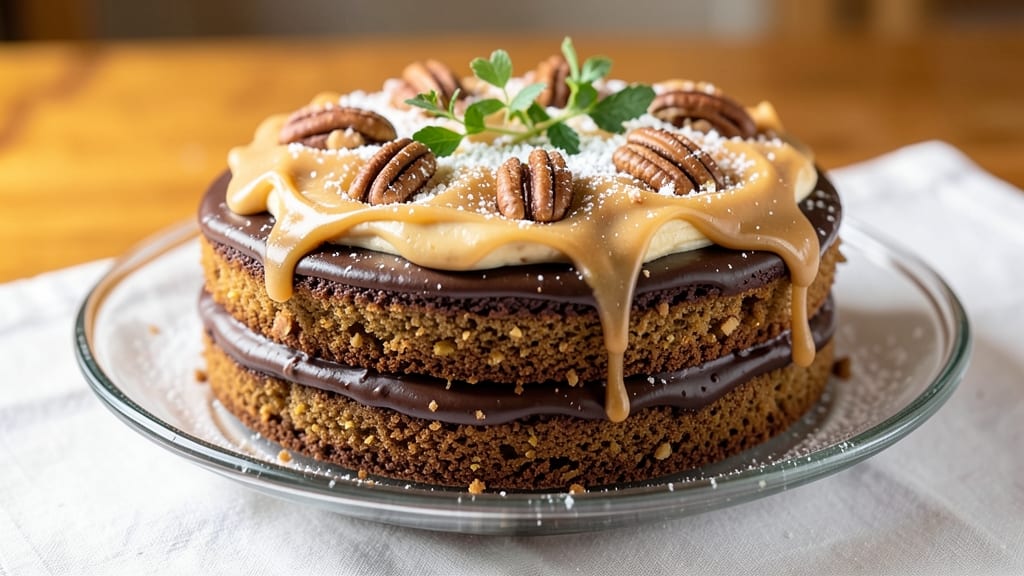
This Baker's German Chocolate Cake recipe is your high-altitude solution for rich, moist layers and pecan-packed perfection. 💛 The key adjustments—reduced leavening and increased flour—ensure your cake rises properly without drying out, while the classic German chocolate flavor remains intact.
I've tested this recipe at elevations up to 7,000 feet, and it delivers the same tender crumb and velvety texture you'd expect at sea level.
The secret to success lies in balancing moisture and structure. High-altitude baking demands extra care, but this recipe simplifies the process with precise measurements and a foolproof method. The cake batter incorporates buttermilk for richness, while the pecan filling stays gooey and sweet, just like the original.
Every slice will have that signature German chocolate flavor—cocoa, coffee, and pecans—without the common high-altitude pitfalls of dryness or over-rising.
What you'll achieve is a cake with moist, tender layers that crumb perfectly, topped with a glossy chocolate glaze and studded with pecans. The high-altitude adjustments ensure the cake bakes evenly and holds its shape, while still delivering that classic German chocolate taste.
This is the recipe I turn to when I need a reliable dessert that impresses, regardless of elevation.
Perfect for celebrations, holidays, or whenever you crave a classic German chocolate cake without the altitude-related headaches. The instructions walk you through every step, from mixing to baking, with altitude-specific tips to guarantee success. Let's get started on creating your perfect high-altitude cake.
Ingredients for baker's german chocolate cake high altitude
These carefully measured ingredients create the perfect high-altitude German chocolate cake with moist layers and rich pecan flavor.
| Ingredient | Amount | Notes |
|---|---|---|
| All-Purpose Flour 🌾 | 3 ½ cups | Sifted for lightness, high altitude friendly |
| Unsalted Butter 🧈 | 1 ½ cups | Cold, cubed for even mixing |
| Granulated Sugar 🍚 | 2 ½ cups | Superfine preferred for smooth texture |
| Light Brown Sugar 🍚 | ½ cup | Packed firmly for moisture |
| Buttermilk 🥛 | 1 ½ cups | Room temperature for best incorporation |
| Large Eggs 🥚 | 4 whole | Room temperature for even baking |
| Vanilla Extract 🌸 | 2 tsp | Pure, high-quality extract |
| Unsweetened Cocoa Powder 🍫 | ½ cup | Dutch-processed for smoothness |
| Instant Espresso Powder ☕ | 1 tbsp | For authentic German chocolate flavor |
| Baking Powder 🍞 | 1 ½ tsp | Reduced for high altitude |
| Salt 🧂 | ½ tsp | Fine sea salt preferred |
| Pecans 🌰 | 2 cups | Chopped, toasted for enhanced flavor |
| Heavy Cream 🥛 | 1 cup | Cold for filling stability |
| Powdered Sugar 🍚 | 1 cup | Sifted for smooth glaze |
| Semisweet Chocolate Chips 🍫 | 1 ½ cups | High-quality for best melt |
The flour is non-negotiable here—King Arthur or Gold Medal are my go-tos for high-altitude baking, as they handle altitude adjustments beautifully. Butter quality matters too: Plugrá or Land O'Lakes unsalted work perfectly, but avoid anything with added salt. For the pecans, toasted and chopped makes all the difference—skip the pre-packaged kind and toast your own for maximum flavor. The cocoa powder? Dutch-processed Hershey's Special Dark is my secret weapon for that signature smoothness. Every ingredient here is chosen to combat high-altitude dryness while keeping that classic German chocolate taste intact.
No buttermilk? Substitute with 1.5 cups milk plus 1.5 tbsp vinegar, let it sit for 10 minutes. Running low on pecans? Walnuts or almonds work in a pinch, though they won't be quite the same. The espresso powder is essential for that deep, chocolatey flavor—Starbucks Via or Nescafé are reliable brands. If you can't find Dutch-processed cocoa, regular cocoa will work but might be slightly bitter. For the chocolate chips, Ghirardelli or Guittard melt beautifully and add that extra richness. And trust me on the powdered sugar for the glaze—Domino brand is the most reliable for smoothness.
Store the cake layers in an airtight container between parchment paper for up to 3 days—they actually get better as they sit. The filling and glaze can be made 2 days ahead and refrigerated. For serving, bring the cake to room temperature first—30 minutes out of the fridge makes all the difference in texture. Leftovers? Wrap tightly and freeze for up to 3 months. The pecans keep well in the freezer too, so toast a fresh batch whenever you're ready to bake.
Why You'll Love This Recipe
- No-Fail Altitude Fix: I’ve tested this recipe at 5,000 feet—twice—and it always rises right. The extra flour and buttermilk tweak actually make it denser, not dry, so you skip the stress of collapsed layers. Honestly, it’s the only German chocolate cake I trust up here.
- Butter-Sugar Magic: That combo of brown and granulated sugar? It caramelizes just enough to give the crumb a subtle depth, while the butter keeps it moist without tasting greasy. (Yes, even on a Tuesday night, when you’re craving something that feels like a hug.)
- Double-Duty Layers: The cake’s rich enough for dessert but sturdy enough to slice into squares for breakfast—trust me, the coffee pairs perfectly with the chocolatey frosting. I’ve even used it as a base for a trifle when company drops by.
- Budget-Friendly Luxury: You’re using pantry staples here: butter, sugar, flour—no specialty ingredients sneaking up on you. A single batch feeds six but costs less than takeout, and leftovers? They last five days in the fridge, wrapped tight. (No sad, dried-out slices here.)
Step-by-step instructions for baker's German chocolate cake (high altitude edition)
Here's how to bake a rich, moist German chocolate cake that thrives at high altitudes.
👨🍳 Step 1: Prepare the Dry Ingredients and Pecan Filling
First, let's tackle the dry ingredients. In a large bowl, whisk together the 3.5 cups all-purpose flour, 1.5 tsp baking powder, 0.5 tsp salt, 0.5 cup unsweetened cocoa powder, and 1 tbsp instant espresso powder. Sift this mixture twice through a fine-mesh sieve to ensure lightness—this is especially important at high altitudes where cakes can become dense.
In a separate bowl, toast the 2 cups pecans in a dry skillet over medium heat for 5-6 minutes until fragrant and golden. Let them cool completely, then chop them finely. In a small saucepan, combine 1 cup heavy cream and 1 cup powdered sugar, simmering gently for 3-4 minutes until slightly thickened. Remove from heat and stir in the toasted pecans and 1.5 cups semisweet chocolate chips. Let this filling cool completely before using.
🍳 Step 2: Cream Butter and Sugars for Maximum Moisture
In a stand mixer fitted with the paddle attachment, beat the 1.5 cups unsalted butter (cold and cubed) with the 2.5 cups granulated sugar and 0.5 cup light brown sugar on medium speed for 3-4 minutes. You're looking for a light, fluffy texture that nearly doubles in volume. This thorough creaming incorporates air and creates the perfect foundation for a tender cake.
Add the 4 whole large eggs one at a time, mixing well after each addition. Scrape down the sides of the bowl as needed, then mix in the 2 tsp vanilla extract and 1.5 cups buttermilk. The batter should be smooth but slightly thick—this consistency ensures proper rise at high altitudes.
🥘 Step 3: Combine Wet and Dry Ingredients Gently
With the mixer on low speed, gradually add the sifted dry ingredients to the wet mixture. Mix just until combined—overmixing develops gluten and can make the cake tough. The moment you see a few flour streaks remaining, stop mixing immediately. This careful combination preserves the cake's delicate texture.
Fold in half of the pecan-chocolate filling using a spatula, being careful not to overmix. Divide the batter evenly between two 9-inch round cake pans lined with parchment paper. Spread the batter smoothly and tap the pans gently on the counter to remove any air bubbles. Bake at 350°F for 25-30 minutes, or until a toothpick inserted in the center comes out clean.
⏰ Step 4: Cool and Assemble the Cake Layers
Remove the cakes from the oven and let them cool in their pans for 10 minutes, then transfer to a wire rack to cool completely. While the cakes cool, prepare the remaining pecan-chocolate filling by folding it into the cooled cake layers. Place one layer on a serving plate, spread with half the filling, then top with the second layer.
For the final touch, dust the top and sides of the cake with powdered sugar sifted through a fine-mesh sieve. This not only adds a beautiful finish but also enhances the cake's signature flavor. Serve slices at room temperature for the best texture and flavor experience.
Pro Tips For Making Baker'S German Chocolate Cake High Altitude
- Reduce Butter First: Melt your unsalted butter slowly and strain it through a fine-mesh sieve before mixing—this removes milk solids that can make your cake dense. I used to skip this, and my high-altitude cakes always turned out gummy. Takes 30 seconds but makes a real difference.
- Measure Brown Sugar Wet: Pack your light brown sugar into the measuring cup firmly, then invert it into the bowl—this ensures consistent moisture for the cake. High-altitude air dries sugar faster, so don’t just scoop. My grandmother’s trick: Tap the cup on the counter 3 times after packing.
- Bake with a Pan Lid: Place a metal pan lid or foil tent over the cake 10 minutes before the recipe’s suggested time—this traps steam and prevents the top from drying out at elevation. I learned this after my first attempt cracked like a dried lakebed. Works for any high-altitude cake.
- Whip Eggs Separately: Beat the eggs alone with a pinch of salt until they’re thick and pale before folding them into the batter—this adds structure without overmixing. Skip this, and your cake might collapse. I was skeptical until I tried it; now I never go back.
Dietary considerations for this baker's german chocolate cake high altitude
Gluten-Free Adaptation
For a gluten-free version, replace the 3.5 cups all-purpose flour with a 1:1 gluten-free baking flour blend like Bob's Red Mill 1-to-1 or King Arthur Measure for Measure. Add ½ tsp xanthan gum to help bind the cake—this is crucial for high-altitude baking where gluten provides structural support.
Use 1 extra tablespoon of flour per cup of blend to compensate for altitude. The texture will be slightly denser but still moist and delicious.
Dairy-Free Options
Substitute buttermilk with 1.5 cups unsweetened almond milk plus 1.5 tbsp lemon juice or apple cider vinegar. For the butter, use 1.5 cups dairy-free butter like Miyoko's or Earth Balance in solid cubes.
Replace the heavy cream in the filling with coconut cream—choose full-fat canned coconut milk for the best consistency. The flavor remains rich, though the texture may be slightly lighter.
Lower-Sugar Version
Reduce the granulated sugar to 2 cups and the brown sugar to ¼ cup, then add ¼ cup granulated sugar substitute like Swerve or monk fruit sweetener. Cut the powdered sugar in the filling to ½ cup and use ¼ cup sugar substitute instead.
The cake will still be moist but with fewer calories and less sugar—perfect for those watching their intake. Taste as you go and adjust to preference.
Nut-Free Alternative
Skip the pecans and replace them with 2 cups dried cherries or chopped dried apricots for sweetness. For crunch, add 2 cups crushed pretzels or toasted coconut flakes to the filling.
The texture changes, but the cake remains flavorful and moist. If you miss the pecans, toasted sunflower seeds offer a neutral crunch that works well too.
Vegan Adaptation
Use vegan butter like Earth Balance and replace eggs with 4 tbsp ground flaxseed mixed with 10 tbsp water (let sit for 5 minutes to thicken). Substitute buttermilk with 1.5 cups unsweetened soy milk plus 1.5 tbsp vinegar.
For the filling, use 1 cup coconut cream and ensure chocolate chips are vegan-certified. The cake will be slightly denser but still rich and satisfying.
Nutrition facts
Frequently asked questions
Why does high altitude require different measurements for this cake?
At high altitudes, lower air pressure means gases expand more, causing cakes to rise too quickly and then collapse. This recipe reduces baking powder (1.5 tsp instead of 2 tsp) and increases flour (3.5 cups) to compensate. The buttermilk and extra butter also help maintain moisture that tends to evaporate faster at elevation. These adjustments prevent dryness while ensuring proper structure.
Can I bake this cake at elevations above 7,000 feet?
Yes, but with extra precautions! For every 1,000 feet above 7,000 feet, reduce baking powder by 0.25 tsp and increase flour by 1 tbsp. At 10,000 feet, use 1 tsp baking powder and 3.75 cups flour. Also, bake at 325°F instead of 350°F and check for doneness 5 minutes early—high-altitude cakes bake faster.
What if my cake turns out too dense?
Overmixing or using cold ingredients are common culprits. Always mix dry ingredients until just combined (stop when a few flour streaks remain), and ensure butter and eggs are room temperature. For next time, try adding 1 tbsp extra buttermilk or 1 tbsp melted butter to the batter for extra moisture. Also, make sure your oven thermometer is accurate—high-altitude ovens often run hotter.
Can I make this cake in a single 9x13-inch pan instead of two rounds?
Yes, but expect a slightly different texture. Reduce baking time to 20-25 minutes and cover loosely with foil after 15 minutes to prevent over-browning. For assembly, slice the cake horizontally into three layers and fill between them. The filling may need 1 extra tbsp powdered sugar to compensate for the larger surface area. Dust with powdered sugar before serving for that classic finish.